Rajaji Nagar Thiruvananthapuram Rehabilitation: Can Kerala Turn Inclusive Housing into a Model for Urban Renewal?
From Rehabilitation to Urban Renewal
A 32-family rehabilitation block offers a window into the much larger challenge of rebuilding established urban communities without losing the people who live in them.
The Larger Story Behind Rajaji Nagar Thiruvananthapuram’s New Housing Project
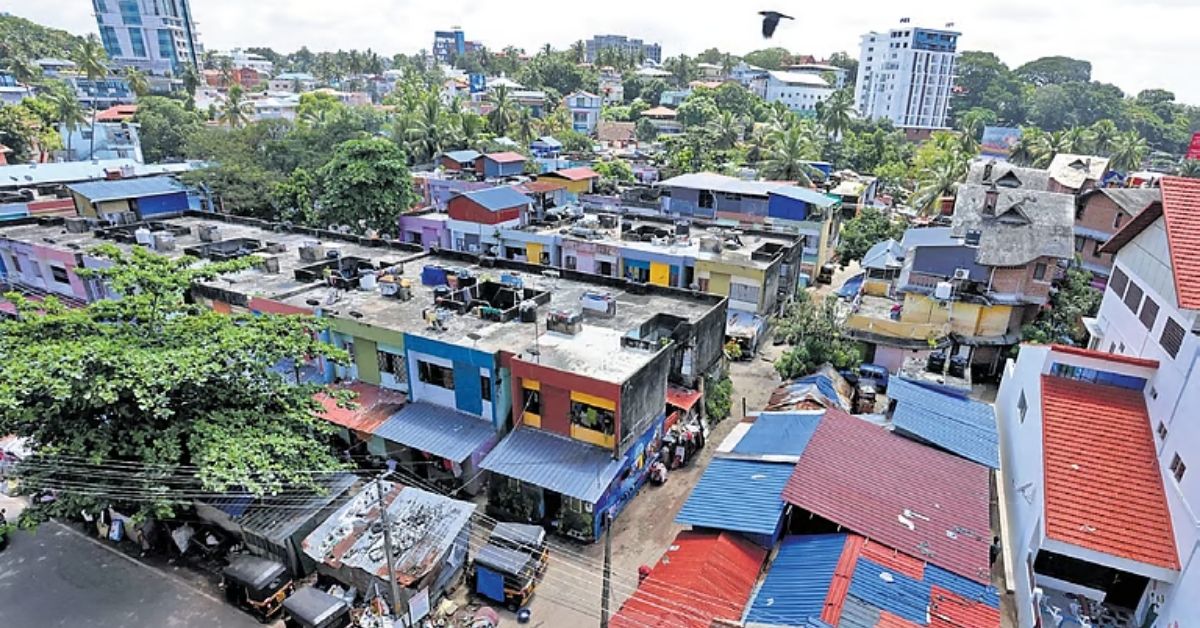
The first phase of the Rajaji Nagar rehabilitation initiative in Thiruvananthapuram marks an important step in the long-running effort to improve living conditions in one of the city’s oldest and most densely populated settlements.
The first rehabilitation block is designed to house 32 families in 2BHK apartments, with the project cost reported at approximately ₹9 crore. The broader redevelopment vision covers a 12.6-acre settlement and includes not only housing, but also drainage, roads, parking and community infrastructure. The first building is designed with scope for vertical expansion, potentially increasing its capacity from 32 to 48 families. (The Times of India)
But the significance of Rajaji Nagar Thiruvananthapuram extends beyond the number of apartments being constructed. The project illustrates the complexity of urban rehabilitation: land constraints, community resistance, beneficiary identification, temporary relocation, construction delays and the challenge of balancing physical redevelopment with social continuity.
For Indian cities, the larger lesson is clear: urban redevelopment succeeds not merely when new buildings are constructed, but when existing communities are able to move into better housing without losing access to livelihoods, social networks and the city itself.
What The Media Captured
There are some differences between official and media descriptions of the project.
The Kerala Local Self Government Department’s official Smart Cities page describes the first phase as development on approximately 36 cents, with 32 dwelling units of approximately 700 sq ft each. Media reports describe the completed/near-completion block as 600 sq ft 2BHK units and the broader first phase as involving 248 units. (LSGD Kerala | തദ്ദേശ സ്വയംഭരണ വകുപ്പ്)
However, on ground, the redevelopment of Rajaji Nagar has been progressing through multiple stages rather than through a single construction event. The first phase is designed around 32 2BHK rehabilitation homes, with published specifications varying between approximately 600 and 700 sq ft depending on the source and project description.
Earlier reports described the project as facing delays related to tendering, limited bidder participation, relocation concerns and resistance over beneficiary identification. Initial plans for large-scale temporary relocation were subsequently modified as authorities attempted to proceed through a more phased approach. (The Times of India)
Construction progress was reported through 2024 and 2025, with the first residential block eventually moving towards completion. Reports in 2025 described the building as nearing completion and identified 32 families as the first beneficiaries. (The Times of India)
Editorial clarification by Rainger Realty Research Desk
The media summary describes rehabilitation beginning in November 2025. But, available reports accessed by our Research Desk indicate that construction activity had already begun earlier, while November 2025 represented a significant stage in the first phase’s rehabilitation/occupancy timeline.
Expansion potential: Additional floors can increase capacity to 48 families
Broader redevelopment plan: 248 housing units plus roads, drainage, parking and community spaces
Implementing agency: Smart City Thiruvananthapuram Ltd (SCTL)
Policy context: Smart City Mission
Key challenge: Rehabilitation and relocation of an established community while executing redevelopment in phases (The Times of India)
THE 360° RAINGER REALTY RESEARCH DESK ANALYSIS
What Is Actually Being Redeveloped?
At first glance, Rajaji Nagar appears to be a housing project. But it is more accurately an urban regeneration project.
The difference matters, as, while a housing project primarily creates homes, an urban regeneration project must address Housing quality, Infrastructure, Drainage, Access roads, Parking, Community spaces, Safety, Livelihood continuity, Social integration and Long-term maintenance.
The Rajaji Nagar plan incorporates several of these components, including housing and supporting infrastructure. (The Times of India)
Why Is the Project Important?
Because the settlement is located in the core urban area of Thiruvananthapuram.
This creates a major urban planning dilemma:
Option A — Relocate the community away from the city
Advantages:
Easier land assembly
Lower construction costs
More planning flexibility
Disadvantages:
Loss of access to employment
Longer commutes
Social disruption
Possible weakening of established community networks
Option B — Redevelop in place
Advantages:
Existing residents remain near employment and services
Land is used more efficiently
The community can be upgraded without complete displacement
Disadvantages:
Construction becomes more complex
Temporary relocation is necessary
Resident cooperation becomes critical
Phased execution takes longer
Rajaji Nagar represents the second and more complex model.
Can Slum Rehabilitation Create Value Without Displacement?
This is one of the most important questions facing Indian cities.
The traditional urban development model often works like this:
Informal settlement
↓
Land becomes valuable
↓
Residents are displaced
↓
New development arrives
A more inclusive model seeks to create:
Existing community
↓
In-situ redevelopment
↓
Better housing + infrastructure
↓
Community remains connected to the city
The second model is much harder to implement. But when successful, it can create a more socially sustainable urban outcome.
Why Relocation Is So Difficult?
The difficulty is not simply that residents resist change. There are often legitimate concerns.
1. Livelihood Risk
Many residents may work close to their existing location. Moving them far away can increase: Travel time, Transport costs, Employment risk.
2. Social Networks
Established communities often provide: Informal childcare, Social support, Emergency assistance, Community-based employment networks. Relocation can unintentionally break these networks.
3. Beneficiary Identification
“Who is entitled to rehabilitation?” This is often one of the most politically and socially sensitive aspects of redevelopment.
4. Temporary Housing
Residents may ask: “Where will we live during construction?” The temporary accommodation related answer must be credible.
5. Trust Deficit
If redevelopment promises have been delayed for years, residents may not immediately trust a new announcement.
The Rajaji Nagar project itself experienced delays and community concerns, illustrating why social engagement is as important as construction management. (The Times of India)
What Does The ₹9-Crore Figure Really Tells Us?
At a simple level:
₹9 crore ÷ 32 families = approximately ₹28.1 lakh per family.
But this should not be interpreted as the construction cost of a 2BHK apartment alone.
The project cost may include broader elements such as:
Site development
Structural works
Common areas
Infrastructure
Professional fees
Construction-related costs
Project management
Associated development works
Therefore, the figure is best understood as:
A broad project-level investment of approximately ₹9 crore for the first 32-family rehabilitation block, rather than a direct market price for each apartment.
This is a critical distinction.
Why Vertical Development Matters
The first block has been designed with the possibility of adding two more floors, potentially increasing capacity from 32 to 48 families. (The Times of India)
This illustrates a fundamental urban planning principle: In land-constrained cities, the future capacity of a building can be as important as its present capacity.
Vertical expansion can:
Increase housing supply without acquiring additional land
Improve land-use efficiency
Support phased rehabilitation
Reduce the need for outward urban expansion
However, this requires proper attention to:
Structural capacity
Fire safety
Vertical transportation
Water supply
Waste management
Open spaces
Parking
Maintenance
A building cannot simply become taller without its supporting infrastructure also being designed for increased demand.
Why This Is A Real Estate Story
This is not a conventional property investment story.
There is no conventional:
Launch price
Investor return
Rental yield
Developer sales programme
Yet it is fundamentally a real estate story because it involves:
Land: A scarce urban resource.
Density: How many people can live within limited land?
Housing: How should urban housing be provided?
Infrastructure: Can roads, drainage and public services support the population?
Urban Economics: How can cities accommodate lower-income communities in locations where land values are rising?
Social Sustainability: Can urban development improve lives without forcing vulnerable communities to the margins?
This is exactly why urban planning and real estate economics cannot be studied separately.
The Thiruvananthapuram Context
Rajaji Nagar’s location is strategically significant because it is situated in the central urban fabric of Thiruvananthapuram.
The project therefore raises a larger question:
What happens when the land occupied by an established low-income community becomes increasingly valuable because the city around it is growing?
The answer cannot simply be: “Move the residents somewhere else.”
Modern urban planning increasingly recognises that housing, employment and mobility are interconnected.
A family may be physically housed but economically disadvantaged if the new location disconnects it from:
Employment
Schools
Healthcare
Transport
Family networks
Therefore, successful rehabilitation should be judged by more than:
“How many homes were constructed?”
It should also ask:
“How many livelihoods, relationships and opportunities were preserved?”
The Global Perspective
The Rajaji Nagar story reflects a global urban challenge.
Cities worldwide have struggled with the question of how to upgrade informal settlements.
The broad approaches include:
1. Relocation: Move residents elsewhere.
2. In-Situ Upgrading: Improve the existing settlement.
3. In-Situ Redevelopment: Replace poor-quality housing with planned housing while keeping residents in the same broader location.
4. Community-Led Development: Allow residents to participate directly in planning and implementation.
The most successful model is not necessarily the most expensive one, but the one that combines: Better housing + infrastructure + affordability + social continuity + long-term maintenance.
WHO BENEFITS?
Existing Residents: They receive improved housing and infrastructure.
The City: It gains better planned land use and upgraded urban services.
Government: It demonstrates a more structured approach to rehabilitation.
The Local Economy: Construction and infrastructure investment create economic activity.
Future Urban Planning: The project may provide lessons for other cities facing similar redevelopment challenges.
WHAT MAY BE AT RISK?
Redevelopment is not automatically successful.
Potential risks include:
Construction Delays: A phased project can lose momentum.
Incomplete Rehabilitation: A first phase may be completed while later phases remain uncertain.
Beneficiary Disputes: Disagreement over eligibility can delay implementation.
Temporary Relocation Problems: Families may face hardship during construction.
Maintenance Failure: New buildings can deteriorate if long-term maintenance is neglected.
Social Disruption: Residents may lose important community networks.
Infrastructure Overload: More apartments require sufficient water, drainage, waste management and transport.
The Biggest Lesson
The most important lesson from Rajaji Nagar is this:
Urban redevelopment is not primarily a construction problem. It is a coordination problem.
Planning and execution of such a sensitive project requires seamless coordination between:
Government
Urban planners
Engineers
Contractors
Residents
Community representatives
Social organisations
Financial institutions
Local authorities
A technically excellent building can still fail as an urban project if the people who are supposed to live there do not trust the process or cannot sustain their livelihoods.
The Real Value of Rajaji Nagar Thiruvananthapuram May Not Be Measured in Apartments
The first phase of Rajaji Nagar Thiruvananthapuram’s rehabilitation is modest when measured purely in numbers: 32 families, one residential block and a ₹9-crore project investment.
But its importance lies in the model it could represent.
Indian cities are becoming more land-constrained, more expensive and more densely populated. The future of urban housing cannot depend entirely on endlessly expanding city boundaries.
The more difficult question is how existing communities can be upgraded within the urban fabric.
Rajaji Nagar offers a live example of that challenge.
If the project can successfully combine new housing, improved infrastructure, community participation and long-term maintenance, it could offer useful lessons for other Indian cities.
The true measure of success will not be the number of buildings constructed.
It will be whether redevelopment delivers Better housing without disintegrating the community.
Disclaimer
This article is based on publicly available information reported by the original sources. Rainger Realty Research Desk has added its own commentary and analysis for informational purposes. Readers should refer to the original publisher(s) for the complete news report.
Appreciate the efforts you made to get us the NA plot at Gruh Gardens Ahmedabad. Your support was very useful for an NRI like me. Thanks a lot.
Rocky Fernandez
Finance Manager at Roztec Pharma UK
NA Plot in Karjat Waters
Appreciate you for getting us very good deal. It was a nice and smooth transaction.. from start till registration and possession. Your team was very supportive, especially Mayank. Thank you.
Manjula Srivastava
Civil Engineer from Fort Mumbai
2 bhk in Sanghvi Golden City
Happy with the deal. Your support team was wonderful. Thanks a lot.
Ragini Malhotra
CA from Thane
Na Plot in Brooksville, Karjat
Happy with your recommendation Rainger Realty. Very good ROIC within 2 years. Thank you
Chinmoy Sahu
Owner, Tanuja Exports, Vashi
Apartment in Rose Gardens, Asangaon
Good cozy apartment. Nice Society, very next to a mainstream national highway. Also very close to a railway station. My parents are living happily.