How International Airports Create Billion-Dollar Real Estate Corridors: Global Lessons for Navi Mumbai Investors
From International Airport to Aerotropolis
The Economic Forces That Create Global Real Estate Corridors
Why do some international airports transform entire regions into thriving business districts, logistics hubs and premium real estate destinations — while others remain little more than transportation facilities?
The answer rarely lies on the runway alone.
Across the world, the most successful airport regions have evolved into complex economic ecosystems where aviation interacts with business, logistics, employment, infrastructure, hospitality, technology and urban planning.
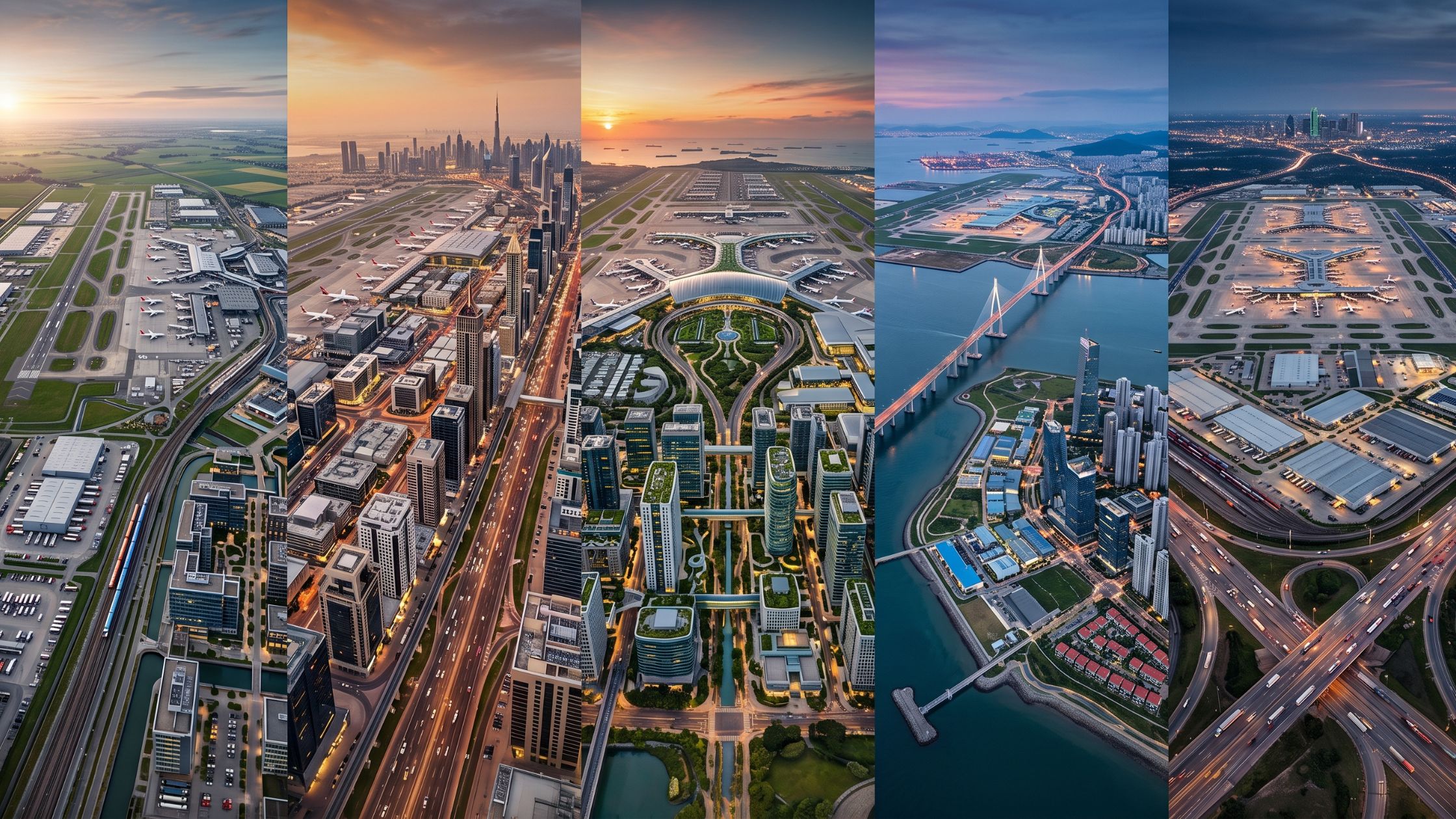
This article examines five major global airport regions—Amsterdam Schiphol, Dubai, Singapore Changi, Incheon and Dallas–Fort Worth—to understand what made them successful.
It then applies those lessons to Navi Mumbai International Airport, examining the region’s emerging convergence of aviation, maritime trade, road connectivity, metro infrastructure, planned urban development and logistics.
The objective is not to predict property prices, but to understand the economic mechanisms that can create long-term real estate value.
KEY TAKEAWAYS
An airport alone does not guarantee real estate appreciation.
Employment creation is one of the strongest long-term drivers of property demand.
Global airport cities developed through infrastructure, business attraction and long-term planning.
Airport proximity is less important than accessibility and economic activity.
Schiphol demonstrates the AirportCity model.
Dubai demonstrates how aviation can integrate with tourism, trade, finance and global business.
Singapore Changi demonstrates the importance of integrated planning and logistics.
Incheon demonstrates the power—and risk—of large-scale planned development.
Dallas–Fort Worth demonstrates how airports amplify a diversified regional economy.
Navi Mumbai’s distinctive strength is infrastructure convergence.
Its future success will depend on execution, employment, commercial absorption, governance and time.
The runway may be the beginning of the story. The economic ecosystem determines what happens next.
WHY THIS ARTICLE MATTERS
Every major airport announcement is followed by familiar claims:
“Property prices will soar.”
“Buy before it is too late.”
“This is the next big investment corridor.”
But global experience is more complicated.
Some airport regions have become extraordinary economic engines.
Others have experienced:
slower-than-expected commercial growth;
excess development;
weak employment creation;
delayed infrastructure;
poor connectivity;
insufficient business demand.
The real question is therefore not:
“Does an airport increase property prices?”
It is:
“What economic ecosystem develops around the airport?”
That distinction is particularly important for investors evaluating Navi Mumbai International Airport Real Estate.
WHY YOU CAN TRUST THIS ANALYSIS
At Rainger Realty Research & Insights, we believe that meaningful real estate decisions require more than headlines and promotional claims.
This analysis uses a comparative framework:
We examine:
transport infrastructure
business ecosystems
logistics hubs
employment opportunities
planning
commercial development
governance
real estate diversification
long-term execution.
The objective is not to make speculative price predictions.
It is to help readers understand:
“Which conditions create durable real estate value—and which assumptions should be treated with caution.”
THE CORE QUESTION
Imagine standing inside a major international airport.
Aircraft arrive carrying:
corporate executives
investors
tourists
engineers
entrepreneurs
skilled professionals.
✔ Cargo terminals move high-value goods.
✔ Hotels accommodate international visitors.
✔ Business parks host corporations.
✔ Expressways connect manufacturing centres.
✔ Metro systems connect commercial districts.
✔ Logistics hubs operate around the clock.
But the relationship is usually more complicated that common understandings.
It may appear that the Airport created the entire economic ecosystem. But, actually, the airport is often one part of a broader system.
That distinction matters.
Because an Airport can improve Connectivity.
But businesses built around it create employment opportunities.
Employment increases population and drivesincome.
The increasing Population, Income and the Business activities create demand for:
offices
warehouses
hotels
retail
housing
education
healthcare
entertainment.
That is the mechanism through which airport connectivity can eventually translate into real estate value.
AIRPORT CITY VS AEROTROPOLIS
What Is an Airport City?
An AirportCity is a concentrated economic district built around an airport.
It may contain:
offices;
hotels;
retail;
logistics;
convention centres;
business services;
cargo infrastructure.
Schiphol Amsterdam International Airport is a particularly useful example because its own operating model explicitly integrates aviation, consumer services and real estate. Schiphol describes its AirportCity model as combining aviation with commercial activities and real estate around the airport, including offices, logistics buildings and hotels. (Schiphol)
What Is an Aerotropolis?
An Aerotropolis is a much larger metropolitan economic region structured around airport connectivity.
It may include:
Airport
↓
Transport Network
↓
Logistics
↓
Business Districts
↓
Employment
↓
Housing
↓
Urban Expansion
The airport becomes the central gateway of a broader economic geography.
THE AIRPORT VALUE CREATION CHAIN
The most important framework in the article
International Connectivity
↓
Business Investment
↓
Employment Creation
↓
Logistics + Commercial Development + Hospitality
↓
Urban Growth
↓
Residential Demand
↓
Long-Term Real Estate Value
The airport supports this system. It does not replace it.
This is the central principle for evaluating Navi Mumbai.
GLOBAL CASE STUDY 1 — AMSTERDAM SCHIPHOL
From Airport to AirportCity
Amsterdam Schiphol is one of the clearest examples of a modern AirportCity.
The Schiphol model deliberately combines:
aviation;
commercial activity;
logistics;
offices;
hotels;
real estate.
Schiphol Real Estate describes the airport area as a major business location with hundreds of companies and a dedicated real estate development function. (Schiphol)
What transformed the region?
Not simply the airport.
The transformation came from:
international accessibility;
strong national connectivity;
business concentration;
commercial real estate;
logistics;
long-term land management.
Real Estate Impact
The airport region supports:
offices;
logistics;
hotels;
business services;
commercial activity.
Lesson for Navi Mumbai
An airport must become a business location—not merely a place where aircraft land.
GLOBAL CASE STUDY 2 — DUBAI
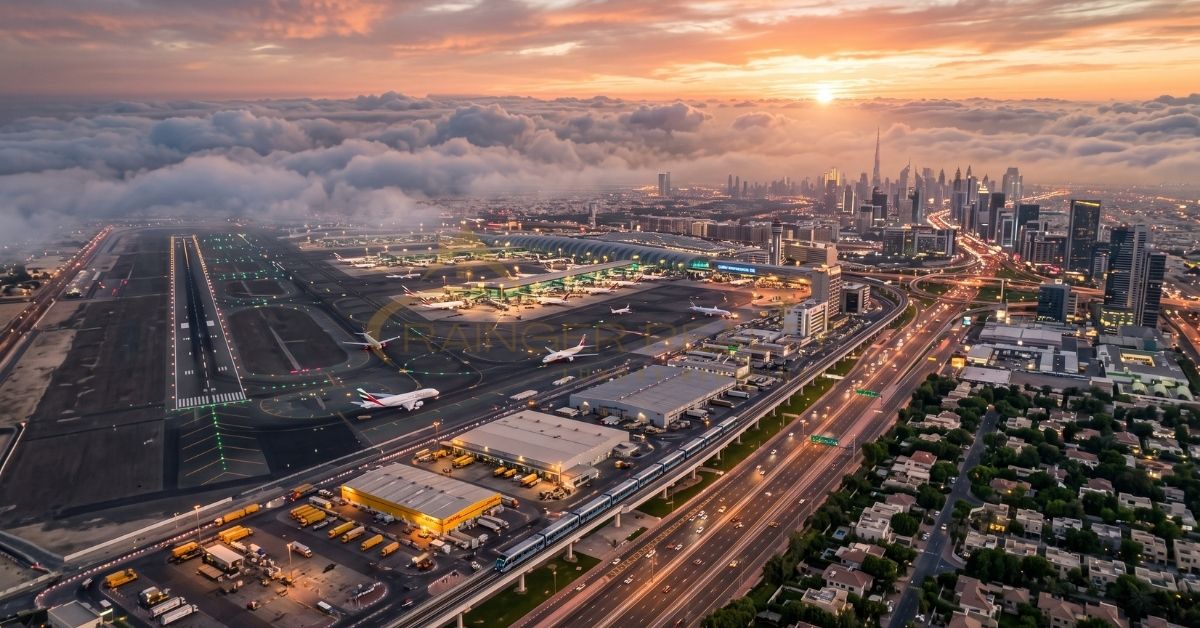
Aviation as a Global Economic Platform
Dubai demonstrates the power of integrating aviation with a broader global economic strategy.
The airport supports an ecosystem involving:
international tourism;
trade;
finance;
hospitality;
logistics;
global business;
residential development.
Dubai International Airport handled a record 95.2 million passengers in 2025, remaining the world’s busiest airport for international passenger traffic. The airport is closely connected to Dubai’s wider tourism, business and real estate economy. (AP News)
The Lesson
Dubai did not simply build an airport and wait for development.
It built:
global connectivity;
business infrastructure;
tourism;
free-zone ecosystems;
hospitality;
international investment platforms.
Real Estate Lesson
The airport helped connect Dubai to the world.
But economic diversification created the demand.
Lesson for Navi Mumbai
Connectivity is most powerful when it is connected to a clear economic strategy.
GLOBAL CASE STUDY 3 — SINGAPORE CHANGI
Infrastructure as a National Economic Strategy
Singapore demonstrates a different model.
Here, airport development is part of a much broader national infrastructure and economic strategy.
The airport interacts with:
trade;
manufacturing;
logistics;
finance;
technology;
business services.
Lesson for Navi Mumbai
The lesson is not simply:
“Build an airport and development will follow.” or “How many passengers will the airport handle?”
It actually is:
“What industries will use the created connectivity?”
In a nutshell, the learning is that:
“An airport becomes powerful when it is integrated into a larger economic system.”
GLOBAL CASE STUDY 4 — INCHEON, SOUTH KOREA
The Power—and Risk—of Planned Development
Incheon provides a particularly important lesson for Navi Mumbai because it demonstrates how airport development can be combined with large-scale planned urban development.
The model includes:
airport infrastructure;
planned business districts;
logistics;
new urban development;
international connectivity.
But planned development also carries risks.
Demand does not always arrive at the same speed as infrastructure.
This creates the possibility of:
underutilised commercial space;
delayed absorption;
excessive supply;
long development timelines.
Lesson for Navi Mumbai
“Large-scale planning must be matched by real commercial demand.”
GLOBAL CASE STUDY 5 — DALLAS–FORT WORTH
The Airport as an Economic Amplifier
Dallas–Fort Worth demonstrates another model.
The airport operates within a large and diversified metropolitan economy.
DFW Airport reports more than $78 billion in annual economic impact and supports approximately 684,000 jobs across the region, according to a 2025 economic impact study. (Dallas Fort Worth International Airport)
The region supports:
technology;
healthcare;
manufacturing;
financial services;
logistics;
telecommunications;
corporate headquarters.
The airport did not need to create an economy from nothing. It amplified an already diversified economic region.
Lesson for Navi Mumbai
“Airports are often most powerful when they strengthen an existing economic base.”
WHAT DO SUCCESSFUL AIRPORT CITIES HAVE IN COMMON?
Success Factor
Global Evidence
International connectivity
Strong
Multimodal transport
Strong
Employment ecosystem
Essential
Logistics Infra
Major contributor
Commercial development
Essential
Long-term planning
Critical
Efficient Governance
Critical
Business attraction
Essential
Residential demand
Usually follows employment
Time-bound implementation
Measured in decades
The key conclusion:
“The airport is rarely the final product. It is the platform.”
THE GLOBAL DEVELOPMENT SEQUENCE
Vision
↓
Infrastructure Investment
↓
Connectivity
↓
Business Attraction
↓
Employment
↓
Commercial Development
↓
Residential Demand
↓
Mature Urban Ecosystem
Real estate price appreciation is usually a consequence of expansion in economic activities.
WHY NAVI MUMBAI IS DIFFERENT
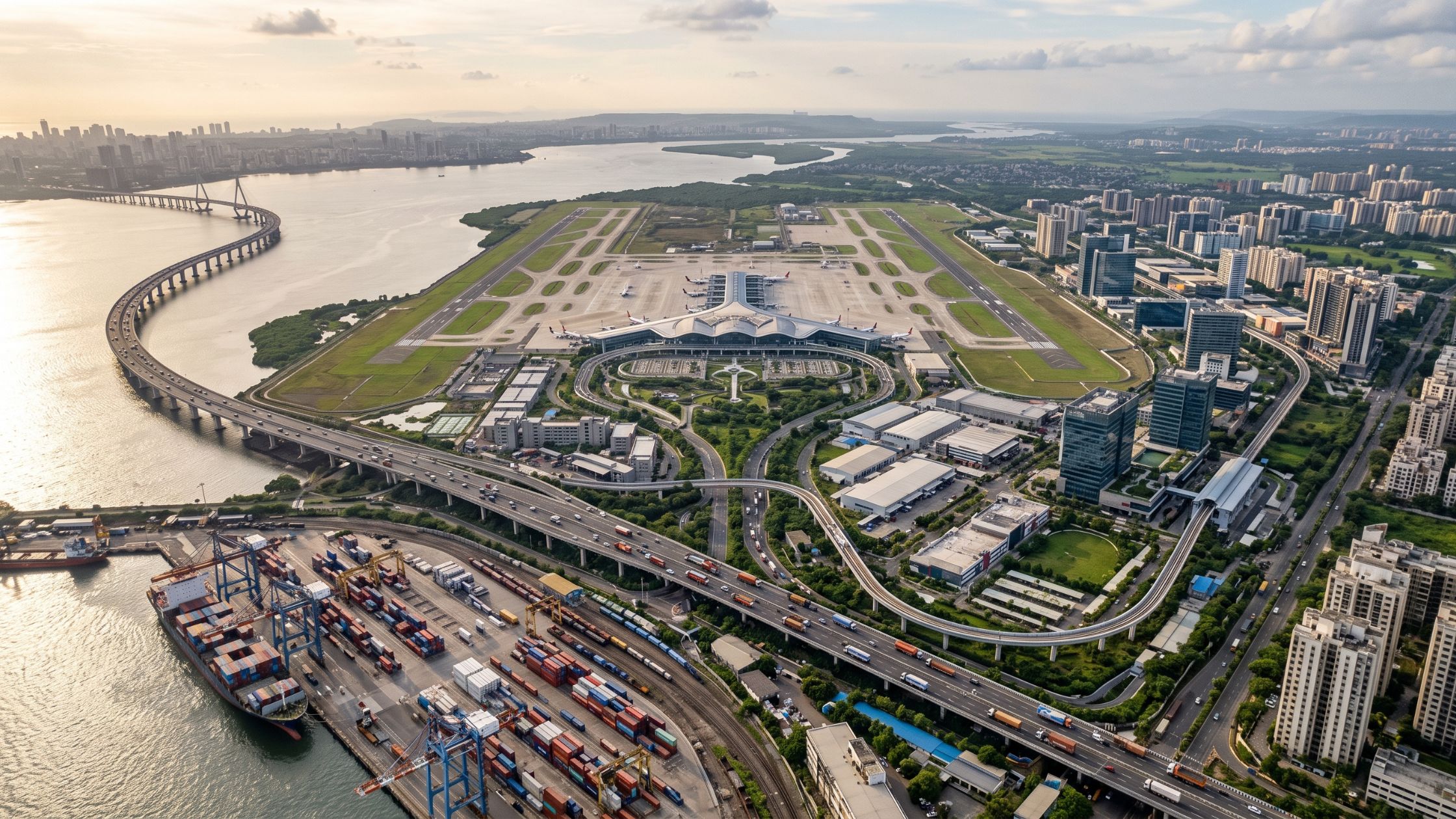
Navi Mumbai International Airport should not be evaluated in isolation.
The larger story is its infrastructure convergence.
The emerging ecosystem includes:
Navi Mumbai International Airport;
Atal Setu / Mumbai Trans Harbour Link;
Jawaharlal Nehru Port;
metro connectivity;
regional highways;
expressways;
logistics infrastructure;
NAINA;
CIDCO’s planned urban development framework.
Atal Setu is a 21.8-km, six-lane bridge that opened to traffic in January 2024 and was designed to improve connectivity between Mumbai and Navi Mumbai, including access towards the airport and JNPA. (MMRDA)
NAINA exists as a planning framework around the airport influence area, with CIDCO acting as the planning authority and maintaining dedicated development-permission and planning systems. (NIAMS)
This means Navi Mumbai is not simply an airport corridor, but is potentially a multimodal economic corridor.
THE INFRASTRUCTURE CONVERGENCE EFFECT
Navi Mumbai’s potential comes from the interaction of multiple systems:
Air: International passenger and cargo connectivity.
Sea: JNPA and maritime trade.
Road: Atal Setu, highways and regional expressways.
Rail and Metro: Urban and regional mobility.
Land: Planned urban development through CIDCO and NAINA.
Logistics: Port-airport-road connectivity.
This creates a potentially powerful proposition: One region. Multiple economic gateways.
WHY JNPA MATTERS
The Navi Mumbai story should not be treated purely as an aviation story. The region also benefits from its relationship with Jawaharlal Nehru Port.
The combination of International Airport + Major Container Port + Road Connectivity + Rail Connectivity + Logistics Infrastructure creates the potential for multimodal supply chains.
This may be particularly relevant for:
e-commerce;
pharmaceuticals;
manufacturing;
high-value logistics;
export-oriented businesses;
time-sensitive cargo.
The opening of major additional container capacity at JNPA has further reinforced the region’s role in India’s maritime logistics ecosystem. (The Times of India)
THE BIG QUESTION:
DOES NAVI MUMBAI MEET THE GLOBAL CHECKLIST?
Success Factor
Global Evidence
Navi Mumbai
International Airport
Essential
Active
Major Port Connectivity
Often present
Active JNPA
Regional Highway Network
Strong
Active + Expanding
Metro Connectivity
Important
Active + Expanding
Planned Urban Development
Strong
CIDCO / NAINA
Logistics Potential
Major
Strong
Employment Ecosystem
Essential
Vibrant + Growing
Commercial Districts
Essential
Existing + Expanding
Social Infrastructure
Essential
Existing + Expanding
Long-Term Governance
Critical
Ongoing
Navi Mumbai has many of the ingredients associated with successful airport-led regions.
But ingredients do not guaranty successful outcomes.
The future of Navi Mumbai will depend on:
commercial absorption;
employment creation;
project execution;
regulatory stability;
private investment;
housing affordability;
infrastructure coordination.
THE OTHER SIDE OF THE RUNWAY
Risks, Realities and Variables That Matter
Risk 1 — Infrastructure Does Not Automatically Create Jobs
An airport can be operational without generating enough surrounding employment.
Risk 2 — Oversupply
If residential or commercial construction runs far ahead of real demand, the market may experience:
vacancy;
slower absorption;
rental weakness;
price stagnation.
Risk 3 — Delayed Commercialisation
Large master plans can take decades to mature.
Risk 4 — Connectivity Gaps
An airport is only useful if people and goods can reach it efficiently.
Risk 5 — Governance and Execution
Long-term urban development requires:
consistent planning;
infrastructure delivery;
regulatory clarity;
institutional coordination.
Risk 6 — Environmental Constraints
Large infrastructure regions must manage:
wetlands;
mangroves;
bird activity;
flooding;
environmental approvals.
Risk 7 — Uneven Regional Growth
Not every location within an airport influence zone will benefit equally.
Risk 8 — Speculative Pricing
Investor enthusiasm can sometimes move prices before the economic ecosystem has matured.
A PRACTICAL INVESTOR FRAMEWORK
The 7-Layer Airport Corridor Test
Do not buy simply because a property is close to an airport.
Layer 1 — Connectivity — How accessible is the location?
How many transport systems connect the location? Not merely the distance, but the Actual travel time matters.
Layer 2 — Employment — What employment is being created?
What industries are generating jobs? Who will live and work there?
Layer 3 — Commercial Demand — What commercial demand exists?
Are businesses actually establishing operations? Are offices, logistics, retail and hotels actually being absorbed?
Layer 4 — Urban Planning — What infrastructure is operational?
Is growth planned or uncontrolled? Do not depend on what just got announced.
Layer 5 — Social Infrastructure — Is the location legally and physically developable?
Are schools, hospitals and community services developing?
Layer 6 — Governance — What is the supply pipeline?
Are plans being executed consistently? Is the future supply pipeline likely to be in excess?
Layer 7 — Time — Is the location suitable for the intended investment horizon?
How long can the investment wait? A long-term corridor may not suit a short-term investor.
A property that scores well across all seven layers deserves deeper evaluation.
RAINGER REALTY RESEARCH DESK INSIGHT
The World’s Leading Airport Cities Did Not Become Successful Because They Built Airports. They became successful because they built economies around the airports.
Navi Mumbai has an unusually powerful combination of infrastructure assets: Connectivity, Employment opportunities, Commercial Demand, Futuristic Urban Planning, Social Infrastructure, Governance and Time-bound development capabilities. But the region’s long-term success will depend on whether these assets work together.
For investors, the lesson is clear: Do not invest in the airport story alone. Evaluate the economic ecosystem. The runway may be the beginning. But, the real estate opportunity — if it emerges — will be created by everything that develops around it.
Disclaimer
This article is based on publicly available information reported by the original sources. Rainger Realty Research Desk has added its own commentary and analysis for informational purposes. Readers should refer to the original publisher(s) for the complete news report.
Appreciate the efforts you made to get us the NA plot at Gruh Gardens Ahmedabad. Your support was very useful for an NRI like me. Thanks a lot.
Rocky Fernandez
Finance Manager at Roztec Pharma UK
NA Plot in Karjat Waters
Appreciate you for getting us very good deal. It was a nice and smooth transaction.. from start till registration and possession. Your team was very supportive, especially Mayank. Thank you.
Manjula Srivastava
Civil Engineer from Fort Mumbai
2 bhk in Sanghvi Golden City
Happy with the deal. Your support team was wonderful. Thanks a lot.
Ragini Malhotra
CA from Thane
Na Plot in Brooksville, Karjat
Happy with your recommendation Rainger Realty. Very good ROIC within 2 years. Thank you
Chinmoy Sahu
Owner, Tanuja Exports, Vashi
Apartment in Rose Gardens, Asangaon
Good cozy apartment. Nice Society, very next to a mainstream national highway. Also very close to a railway station. My parents are living happily.